
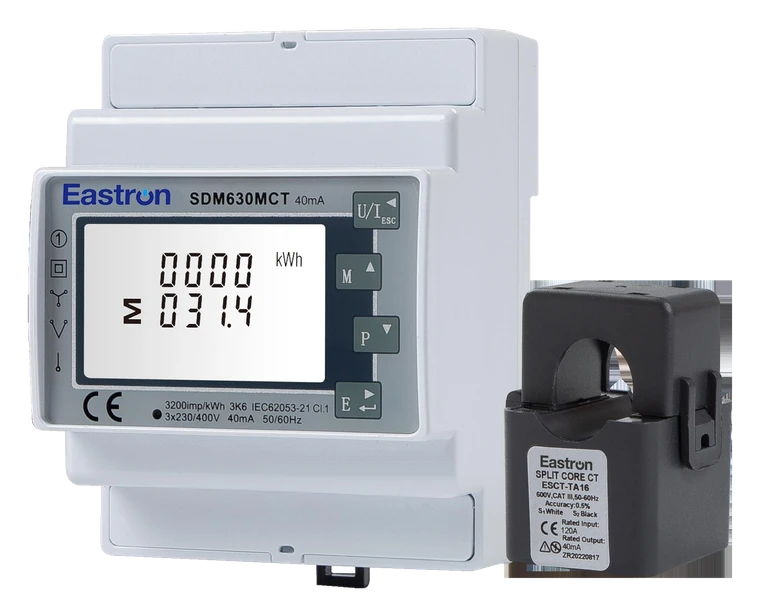
SDM630MCT Meter (Three-Phase)
SDM630MCT-40mA + 3 × ESCT-TA16
The Eastron three-phase CT meter for Deye hybrids — three clip-on CTs, one per phase, so the inverter sees the whole site's import and export. Unlike the single-phase meter it needs its own 85–275 V auxiliary supply. RS485 Modbus, ships at 9600 baud.
- Role
- External grid meter for three-phase Deye hybrids
- Systems
- 1P2W · 3P3W · 3P4W, selectable
- CTs
- 3 × ESCT-TA16 clip-on, 120 A / 40 mA
- Auxiliary supply
- 85–275 V a.c. on terminals 5 / 6 — required
- Communication
- RS485 Modbus RTU, 9600 baud default
- Accuracy
- Class 1.0 active, Class 2 reactive
Specifications
Measurement
- Input voltage
- L–N 100 to 289 V a.c. · L–L 173 to 480 V a.c.
- Input current
- Primary 1–9999 A, secondary 40 mA. Withstands 20× for 0.5 s
- Frequency
- 45–65 Hz
- Accuracy
- Voltage 0.5% · current 0.5% · active power 0.5% · active energy Class 1
- Standards
- GB/T 17215, IEC 62053-21, EN 50470-1/3 · CAT III · IP51 indoor
Terminals
- Voltage input (4-way)
- 1 = N · 2 = L3 · 3 = L2 · 4 = L1
- Current input (6-way)
- L3 → 15/16 · L2 → 17/18 · L1 → 19/20 (S2 to the odd terminal, S1 to the even)
- Auxiliary supply
- 5 = L, 6 = N. 85–275 V a.c. or 120–380 V d.c.
- Voltage output
- 7 = L, 8 = N — passes the supply on
- Pulse outputs
- 9 = +, 10 = −, 11 = + — not used on a Deye system
- RS485
- 12 = GND · 13 = B · 14 = A
Communication
- Protocol
- Modbus RTU, 2400 / 4800 / 9600 (default) / 19200 / 38400 baud
- Address / bus
- 1–247 · up to 64 devices · 1000 m
General
- Dimensions
- 72 W × 94.5 D × 65 H mm, 4-module DIN
- Consumption
- ≤ 2 W
What it is
The three-phase half of the pair. A Deye hybrid can only manage what it can see, and on a three-phase site that means three CTs — one per phase — reporting back over RS485 so zero-export limits, self-consumption logic and the DeyeCloud curves have real numbers to work from. Single-phase sites use the SDM120CTM; the CT part is the same on both.
On the inverter, set Advanced Function → Meter Select to Eastron-3P, and the CT ratio
to 120. The list also holds CHNT-1P and CHNT-3P — a different pinout, and not the meter
we ship.
⚠ It needs its own supply. The single-phase meter does not
Terminals 5 (L) and 6 (N) take 85–275 V a.c. and the meter will not run without them. This is the step people miss when they have only ever fitted the SDM120, which powers itself off its own voltage reference. Terminals 7/8 pass the same supply on to the next device.
Getting the phases right
Each CT’s leads land on that phase’s own pair — L1 on 19/20, L2 on 17/18, L3 on 15/16 — with black to the odd terminal and white to the even, and all three CTs facing the same way, P1 towards the grid.
Cross a CT onto the wrong phase and the meter still reads. It just reads the wrong power, often negative on one line, and nothing on the screen says so. Load one phase at a time and watch it move on its own: kettle on L1, L1 current rises, L2 and L3 sit still. Then L2, then L3. It is the only reliable way to catch a crossed pair.
The CT
ESCT-TA16, 120 A in, 40 mA out, split core, 16.3 mm aperture, class 0.5, 1 m white/black
leads. Three ship in the three-phase carton. The polarity marks sit on P1 and the
white lead, so white is S1, and Eastron’s instruction is “P1 in, P2 out, and the
secondary must never be open-circuited” — land both leads before the conductor goes live.
A 5 A, 1 A or 333 mV CT will not read on this meter. The meter and the CT are a matched 40 mA pair.
Plan & design
Before anything is ordered — sizing, pairing and design decisions for the SDM630MCT Meter (Three-Phase).
Pairs with
Install & commission
On the wall, wired, energised and registered — in the order the job actually runs.
Documents
Everything published for the SDM630MCT Meter (Three-Phase) — and where something is missing, it says so instead of hiding the row.
System & shared documents
Not specific to the SDM630MCT Meter (Three-Phase) — these apply across the range and live here once, not copied per model.
