
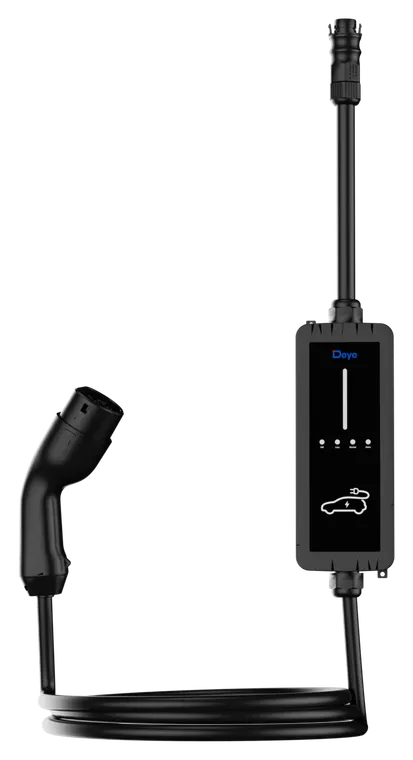
Deye Smart EV Charger · 11 kW / 22 kW
SUN-EVSE11K01-AC · SUN-EVSE22K01-AC
11–22 kW
Smart AC EV charger with a tethered Type 2 connector on a 4.2 m cable. Both models run on single-phase or three-phase: the 11K charges at 3.5 kW single-phase or 11 kW three-phase, the 22K at 7 kW or 22 kW. It runs standalone over Wi-Fi and Deye Cloud, or links to a Deye hybrid through a Smart TX (sold separately) for scheduled, solar-only and outage-aware charging.
- Models
- SUN-EVSE11K01-AC · SUN-EVSE22K01-AC
- Max. charging power
- 11K: 3.5 kW single-phase · 11 kW three-phase — 22K: 7 kW single-phase · 22 kW three-phase
- Rated current
- 16 A (11K) · 32 A (22K)
- Connection
- L+N+PE (single-phase) or 3L+N+PE (three-phase), both models
- Connector
- Type 2, tethered, 4.2 m cable
- Link to a Deye hybrid
- LoRa via a Deye Smart TX (SUN-SMART-TXU1), sold separately
- Communication
- LoRa · Wi-Fi (2.4 GHz) · Bluetooth
- Protection
- IP66 · Type B leakage and 6 mA DC fault protection · Type II surge
- Certification
- RCM, CE, FCC
- Warranty
- 5 years
Specifications
Electrical — SUN-EVSE11K01-AC
- Rated voltage
- 230 V single-phase · 230/400 V three-phase
- Connection mode
- L+N+PE or 3L+N+PE
- Rated current
- 16 A
- Max. output power
- 3.5 kW single-phase · 11 kW three-phase
Electrical — SUN-EVSE22K01-AC
- Rated voltage
- 230 V single-phase · 230/400 V three-phase
- Connection mode
- L+N+PE or 3L+N+PE
- Rated current
- 32 A
- Max. output power
- 7 kW single-phase · 22 kW three-phase
Electrical — both models
- Single-phase wiring
- L1 + N only
- Rated frequency / range
- 50 Hz (45–55 Hz) / 60 Hz (55–65 Hz)
- Starting methods
- Plug & play · scheduled charging
- Max. charge power setting
- Adjustable, 0–22,000 W range (Deye Cloud, local web page or inverter screen)
- Over- / under-voltage trip (default)
- 266.5 V / 182 V, adjustable in Deye Cloud
Protection
- Over- / low-temperature protection
- Yes
- Over- / under-voltage protection
- Yes
- Short-circuit protection
- Yes
- Overload protection
- Yes
- Earth fault protection
- Yes
- Leakage current protection
- DC 6 mA (Deye describes it as Type B leakage protection with 6 mA DC fault detection; see installation notes for the circuit RCD)
- Surge protection level
- Type II
- Emergency stop
- Short press of the function button (LED strip turns red); press again to resume
General
- Operating temperature
- −40 to +55 °C
- Permissible humidity
- 5–95%, non-condensing
- Permissible altitude
- ≤3000 m
- Noise
- <25 dB
- Ingress protection
- IP66
- Control box size (W×H×D)
- 104 × 264 × 58 mm
- Weight
- 3.7 kg
- Charging cable length
- 4.2 m
- Charging connector
- Type 2 · 1 connector
- MTBF
- 100,000 h
- Safety, EMC and standards
- RCM, CE, FCC, EN IEC 61851-1:2019, IEC 61851-1:2017, EN 300 220-2 V3.1.1:2017, EN 300 328 V2.2.2:2019, EN IEC 62311:2020, EN 301 489-1 V2.2.3:2019, EN 301 489-3 V2.3.2:2023, EN 301 489-17 V3.3.1:2024, EN IEC 61000-6-1:2019, EN IEC 61000-6-3:2021, EN IEC 61851-21-2:2021
- Warranty
- 5 years
Communication
- Communication modes
- LoRa · Wi-Fi · Bluetooth Low Energy
- Default mode
- LoRa (switch to Wi-Fi mode for a standalone install)
- LoRa frequency range
- 920–928 MHz
- LoRa antenna
- Internal
- LoRa communication distance
- 200 m (Deye figure; test the link on site)
- Wi-Fi
- 2.4 GHz (2412–2472 MHz)
- Bluetooth Low Energy
- 2402–2480 MHz
- Link to a Deye hybrid
- Deye Smart TX (SUN-SMART-TXU1), sold separately · one charger per Smart TX
- Monitoring and control
- Deye Cloud app and web · hybrid inverter screen when linked
Highlights
- Two models, single- or three-phase. The 11K charges at 3.5 kW on single-phase or 11 kW on three-phase (16 A). The 22K charges at 7 kW on single-phase or 22 kW on three-phase (32 A).
- Standalone or solar-aware. On its own, it runs from a switchboard circuit and is managed over Wi-Fi in Deye Cloud. Linked to a Deye hybrid through a Smart TX, the inverter decides when the car charges and from what: surplus solar, a time window, or as an ordinary load.
- Built for outdoors. IP66, rated −40 to +55 °C, with Type B leakage protection and 6 mA DC fault detection, plus over/under-voltage, over/low-temperature, overload, short-circuit, earth-fault and Type II surge protection.
- Tethered Type 2 connector on a 4.2 m cable, with a connector holster in the box.
- Certified and covered. Deye lists RCM, CE and FCC among the charger’s standards. Its AU brochure (Jul 2026) and the AU user manual (V1.2.0) both give a 5-year warranty.
Which model
| Model | Supply | Connection | Rated current | Max. charging power |
|---|---|---|---|---|
| SUN-EVSE11K01-AC | Single-phase 230 V | L+N+PE | 16 A | 3.5 kW |
| SUN-EVSE11K01-AC | Three-phase 230/400 V | 3L+N+PE | 16 A | 11 kW |
| SUN-EVSE22K01-AC | Single-phase 230 V | L+N+PE | 32 A | 7 kW |
| SUN-EVSE22K01-AC | Three-phase 230/400 V | 3L+N+PE | 32 A | 22 kW |
On single-phase, the charger is wired L1 + N. The 22K draws 32 A on single-phase, and some networks require load management for single-phase EV chargers rated above 20 A, so check the local network’s connection rules as well.
Standalone: Wi-Fi and Deye Cloud
No inverter is needed. Deye’s standalone layout feeds the charger from its own RCD-protected circuit on a sub-board. Connect it to the site’s 2.4 GHz Wi-Fi with the Deye Cloud app or its local web page. From the app you can:
- charge as soon as the car is plugged in (plug and play) or on a schedule
- cap the maximum charging power
- set the over- and under-voltage trip points
- watch charging live and read alerts
The charger’s Wi-Fi module also has Bluetooth. Deye describes it as direct local pairing for quick offline operation, with no network connection needed.
The charger leaves the factory in LoRa mode. On a standalone install, Deye’s manual says to switch it to Wi-Fi mode first from the charger’s local web page: connect to the charger’s own Wi-Fi hotspot, open the local page and set “Working mode 2” to WiFi on the Status page.
With a Deye hybrid: Smart TX and LoRa
Linked to a Deye hybrid, the charger takes its instructions from the inverter. The inverter already knows the solar output, the battery state of charge (SOC) and what the site imports and exports at the grid connection. It uses those readings to send the charger a charging power limit. Deye’s brochure describes this as adjusting charging power to household consumption so the system is not overloaded.
What you need:
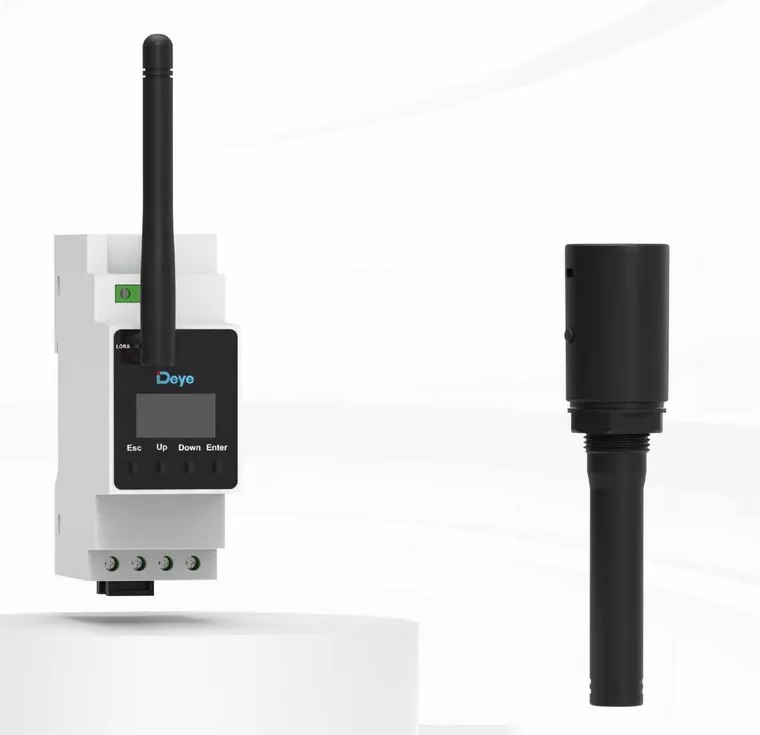
- A Deye Smart TX (SUN-SMART-TXU1). It is a small LoRa transmitter that fits to the hybrid inverter. It is sold separately and is not in the charger box. One Smart TX serves 1 EV charger, 2 Wireless CTs and up to 10 Smart Plugs and Switches in total. On the inverter, enable “EX_Meter For CT” under Advanced Function and set Meter Select to “Smart-TX”. See Smart TX & Wireless CT.
- A compatible inverter on current firmware. Not every Deye hybrid accepts a Smart TX. The inverter needs a Smart Devices item under System Setup. If it is missing, a firmware update may add it, but some older hardware versions cannot take that firmware. Confirm the inverter model and hardware version with Suncloud before quoting.
- A compatible battery for the solar-only and solar-surplus modes. Deye’s EV charger brochure says these modes work only with a Deye hybrid and compatible batteries.
- Pairing. On the inverter screen (System Setup → Smart Devices → Smart EV Charge) or in the Deye Cloud app, enter the charger’s serial number and tick Enable. Then hold the charger’s function button for at least 1 second, until the LED strip turns purple, to scan for the Smart TX channel (default channel 6). After a successful scan, the charger’s LoRa indicator blinks once per second.
The inverter then controls charging through these settings, on its screen or in the app:
| Setting | What it does |
|---|---|
| Plug and play | Charges like an ordinary load whenever the car is plugged in. |
| Time of charge | Four daily windows, each switched on or off. Only the fourth window can run past midnight. |
| Solar energy only | The inverter allows charging only once the battery reaches 99% SOC, and stops it when SOC falls to 95% or below. “Solar sell” under System Work Mode must also be enabled. Deye’s manual adds that, even without enough solar, the charger’s minimum charging current is limited to 6 A. |
| Free work | Both the inverter’s output (solar and battery) and the grid bypass can supply the charger. |
| Off grid EV charge off / Off grid SOC | During an outage, charging continues only while the battery SOC is above the set value. |
| Max charge power | Caps charging in plug-and-play and time-of-charge modes (0–22,000 W range). Off-grid, it cannot be set below 1000 W on single-phase or 4000 W on three-phase. In LoRa mode the charger waits for this value from the inverter each time it starts or restarts. |
| EV_charge device connect at Grid port / LD port | Tells the inverter which side of it the charger is wired to. |
Where the Wireless CT fits
For surplus charging, the inverter has to see the power flow at the grid connection. Deye’s wireless layout does this with a Deye Wireless CT (SUN-SMART-CTU2-L) in the main switchboard. It reports to the same Smart TX over LoRa, so no cable has to run from the switchboard back to the inverter, and the inverter then manages the charger exactly as above. Deye’s EV charger diagrams also show a conventional grid CT. But the Smart TX is enabled through the same Meter Select setting a wired meter uses, so confirm the grid-metering arrangement with Suncloud before you design a site.
Deye’s AU Wireless Energy Management System brochure (31 Aug 2026 update) also shows a layout with no hybrid and no Smart TX: a string inverter or microinverter, a Wireless CT at the main distribution box reporting to Deye Cloud over Wi-Fi, and the charger talking to that CT over LoRa. Deye’s diagram does not name the CT model. Of the two AU Wireless CTs on the 21 Aug 2026 datasheet, only the SUN-SMART-CTU2-WL has Wi-Fi (LoRa, RS485, Wi-Fi and Bluetooth); the SUN-SMART-CTU2-L has LoRa and RS485 only (see Smart TX & Wireless CT). Deye lists Solar-Only and Free Work (plug and play) modes for it and says scheduled charging is not supported in that layout. Neither the charger manual nor Deye’s commissioning guide explains how to set it up, so confirm with Suncloud before you design around it.
Installation notes
- Grid side or backup side. The charger can go on the hybrid’s Load (backup) port, or on the grid side as an ordinary load. Set “EV_charge device connect at Grid port / LD port” to match.
- Circuit protection. Deye describes the charger’s own protection as Type B leakage protection with 6 mA DC fault detection, and its technical table lists DC 6 mA leakage current protection. The charger still needs its own protected circuit: Deye’s AU manual and its standalone layouts show an RCD on the charger’s circuit, and the EU edition of the manual specifies a 30 mA Type A RCD and a circuit breaker for each charger. Design the circuit, its protection and the RCD type to AS/NZS 3000.
- Earthing. Deye requires the charger to be directly earthed in three cases: on a single-phase hybrid, on the grid port of a three-phase hybrid, and standalone. If it sits on the Load port of a three-phase hybrid and must charge off-grid, enable the hybrid’s “signal island mode”. A missing or wrong earth shows as fault F10.
- Cable. Size the AC and PE conductors to AS/NZS 3000 for the rated current (16 A for the 11K, 32 A for the 22K), the run length and the installation method. Do not take the sizes from Deye’s manual table. It pairs 14 AWG with 1.5 mm² (11K) and 10 AWG with 4 mm² (22K), but those are not the same sizes: 14 AWG is about 2.1 mm² and 10 AWG about 5.3 mm².
- In the box. The charger with its 4.2 m cable and Type 2 connector, an AC supply cable, a connector holster with fixings, two M4 × 80 anti-collision bolts and the user manual. There is no Smart TX.
- Siting. The charger is IP66, but Deye asks for shade from direct sun, good ventilation and a spot away from living areas, because it makes some noise in operation.
- Inverter firmware update. If the hybrid needs new firmware to show Smart Devices, Deye has confirmed that the update does not clear the inverter’s existing settings. Only a factory reset does.
Figures are from Deye’s AU datasheet for the SUN-EVSE11K01-AC and SUN-EVSE22K01-AC (21 Aug 2026 edition), the AU Smart EV Charger brochure (8 pages, Jul 2026), the AU Wireless Energy Management System brochure (31 Aug 2026 update), the AU user manual for both models (V1.2.0, dated 15 Jun 2026: settings, wiring, trip points, radio bands, box contents and the 5-year warranty), the EU edition of that manual (V1.2.0, 12 Aug 2026, for the RCD note only), Deye’s Commissioning Steps of the Smart Devices (Ver 1.1, Sep 2026) and Deye’s written advice to Suncloud (Jul 2026: cable length, inverter firmware updates). Confirm the supply arrangement and Smart TX compatibility with the customer’s inverter with Suncloud before quoting.
Plan & design
Before anything is ordered — sizing, pairing and design decisions for the Deye Smart EV Charger · 11 kW / 22 kW.
Pairs with
Operate & configure
Monitoring, tariffs, work modes — getting the most out of the system after handover.
Documents
Everything published for the Deye Smart EV Charger · 11 kW / 22 kW — and where something is missing, it says so instead of hiding the row.
System & shared documents
Not specific to the Deye Smart EV Charger · 11 kW / 22 kW — these apply across the range and live here once, not copied per model.
